
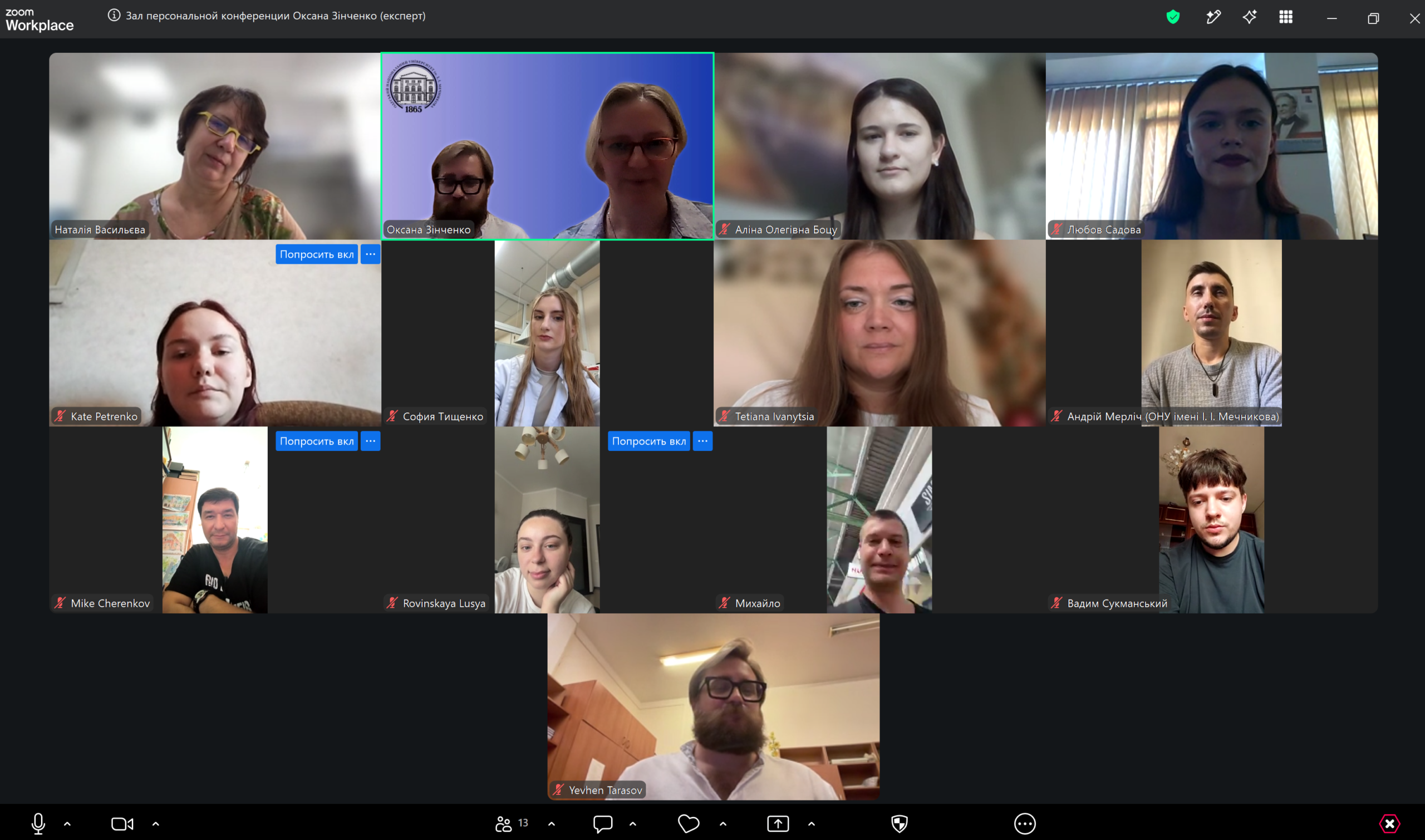
The international hackathon “ResistMap Odesa: Mapping Microbial Resistance in the Black Sea”, organised within the framework of the EU-CONEXUS Enables project, brought together students, teachers and experts to explore digital solutions for one of the Black Sea region’s emerging environmental and public-health challenges.
Organised by Odesa I. I. Mechnikov National University, the hackathon ran from 3 to 21 June 2026 and involved 28 participants working in six teams. Participants included bachelor’s and master’s students, as well as secondary-school students and teachers from Odesa and other parts of the Odesa Region.
For safety reasons, the hackathon was conducted entirely online and asynchronously through Google Classroom. The format enabled participants to access lectures and learning materials safely and at their convenience, collaborate remotely and complete their assignments within the established timeframe.
The hackathon challenged participants to combine scientific knowledge with digital tools and spatial data to better understand and visualise antimicrobial resistance in the Black Sea environment.
From microbiology to geospatial analysis
First place was awarded to a team of master’s students from the Microbiology and Virology programme at Odesa I. I. Mechnikov National University. Their project, “Geoinformation Mapping of the Potential Spread of Antimicrobial Resistance Genes in the Black Sea Based on Bioinformatic Analysis and Marine-Current Modelling,” combined microbiology, bioinformatics and geospatial analysis to examine the potential spread of antimicrobial resistance genes.
Second place went to bachelor’s students from the university’s Biotechnology and Bioengineering programme for their project “Analysis of Antimicrobial Resistance in Odesa Waters.”
Third place was awarded to a team from the Richelieu Lyceum in Odesa for their project “The Digital Twin of Nature.”
All six participating teams also received special jury distinctions recognising different strengths of their solutions: Most Innovative Solution, Best Scientific Rationale, Community-Oriented Solution, Greatest Potential for Impact, Best Use of Spatial Data and Visualization, and Best Practical Solution.
The jury reflected the interdisciplinary nature of the hackathon, bringing together representatives of academia, professional associations and civil-society organisations. Among them were Odesa I. I. Mechnikov National University, Odesa National Medical University, the S. Winogradsky Society of Microbiologists of Ukraine, the Odesa Union of Biologists and Biotechnologists, the All-Ukrainian Association of Clinical Chemistry and Laboratory Medicine, and the Ukrainian Institute of Health Charitable Foundation. The NGO Beregina from Bilhorod-Dnistrovskyi, Odesa Region, also contributed to organising the hackathon.
International expertise through EU-CONEXUS
The programme featured a lecture by Ihor Vasyliev, a specialist in cartography and geoinformation technologies affiliated with the Municipal Enterprise “Traffic Management Center” in Kyiv and the State Enterprise “National Institute for Infrastructure Development.”
The international dimension of the event was strengthened by Dr Swen Meyer, invited lecturer from the Chair of Geodesy and Geoinformatics at the University of Rostock, Germany, one of the EU-CONEXUS partner universities.
By connecting environmental research, digital technologies, education and international expertise, the hackathon reflected the broader goals of EU-CONEXUS ENABLES: strengthening research and innovation capacities, fostering collaboration across institutions and disciplines, and developing solutions relevant to sustainable coastal communities.
“Even in wartime, digital solutions can build bridges between schools, universities, experts and society – turning environmental data into knowledge and knowledge into action for a more resilient Black Sea.”
The official award ceremony is scheduled for the second half of September 2026, when the winning teams will have an opportunity to present their projects. Representatives of the Odesa Regional Council and the Association of Cross-Border Cooperation “Lower Danube Euroregion” are also expected to participate.

Funded by the European Union. Views and opinions expressed are however those of the author(s) only and do not necessarily reflect those of the European Union or European Research Executive Agency. Neither the European Union nor the granting authority can be held responsible for them.