
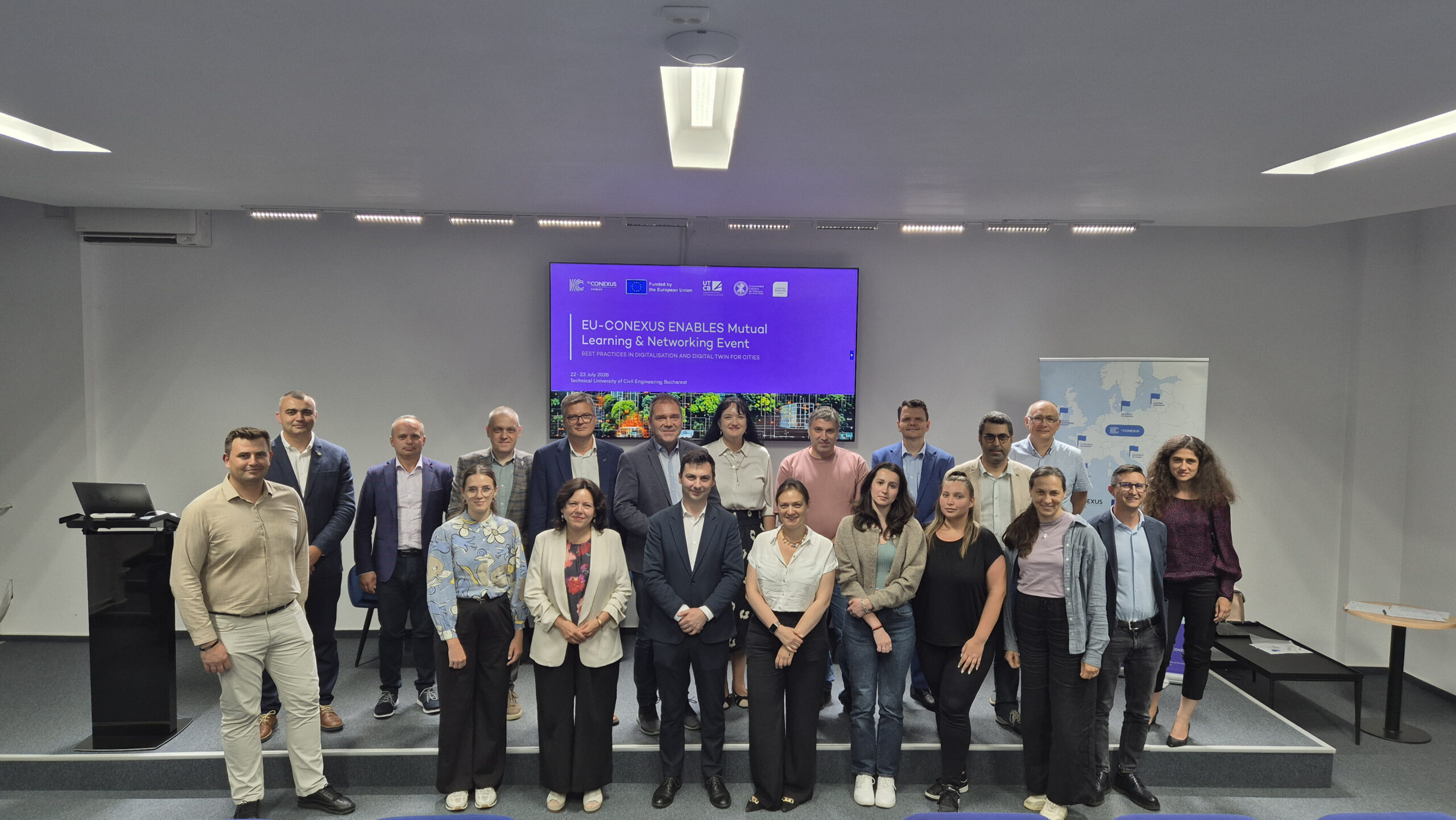
On 22–23 July 2026, the Technical University of Civil Engineering Bucharest (UTCB) hosted two major events under the EU-CONEXUS Enables project, bringing together experts from academia, public authorities and industry to explore how digital technologies are reshaping the future of cities.
The ENABLES Training – Digitalisation, GIS and Digital Twin for Cities and the ENABLES Mutual Learning & Networking Event welcomed participants from municipalities, universities, technology companies and professional organisations across Europe. Together, they exchanged knowledge, shared best practices and discussed innovative approaches to urban digitalisation, Geographic Information Systems (GIS) and Digital Twin technologies.
Building knowledge for smarter urban development
The two-day programme focused on the growing role of digital technologies in creating more efficient, resilient and sustainable cities.
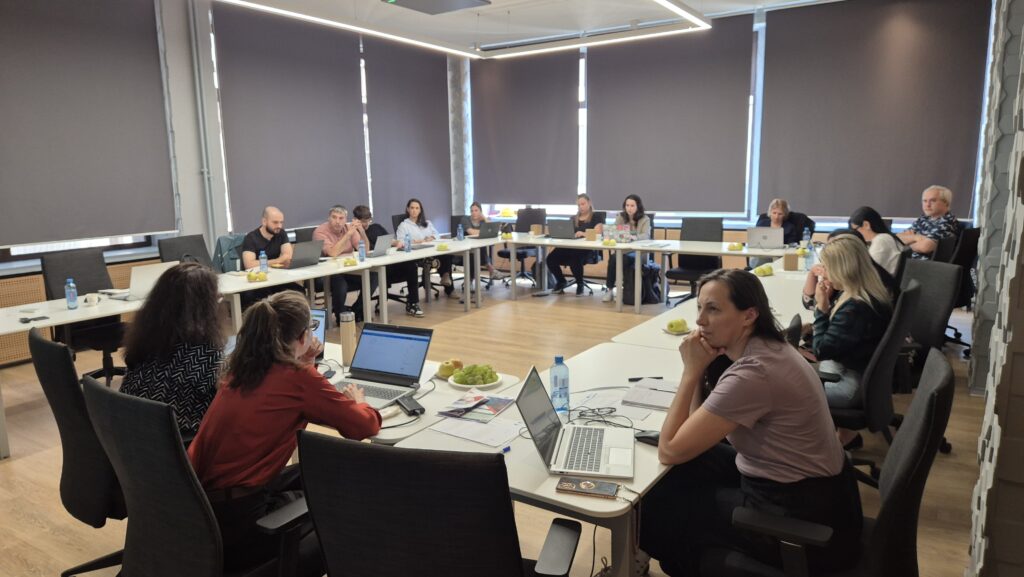
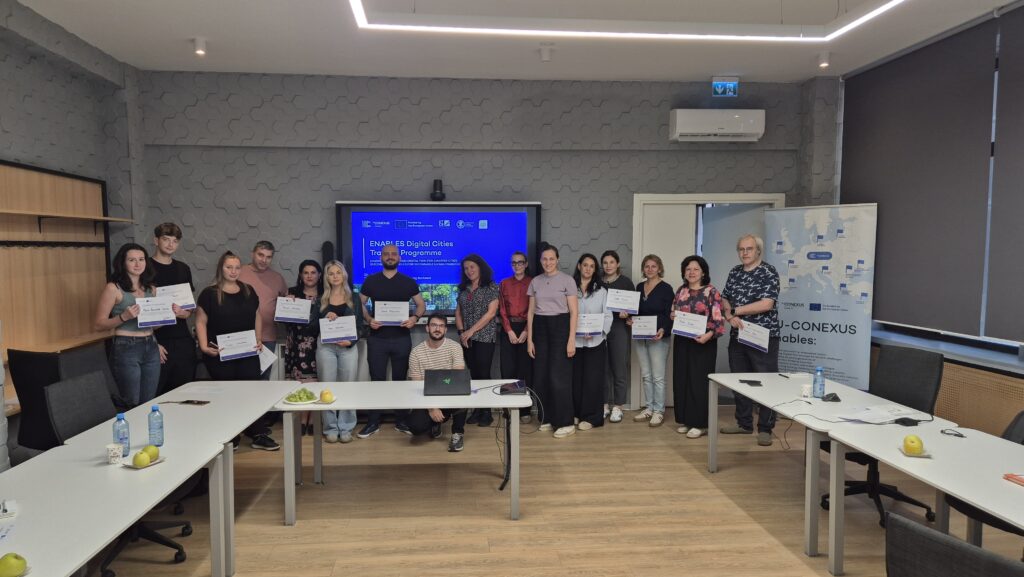
The training sessions introduced participants to the digital transformation of public administration, the fundamentals of Digital Twin technologies and the practical application of GIS tools in urban management. Discussions demonstrated how these technologies can support evidence-based decision-making, improve city planning and enhance public services.
The second day expanded the conversation through practical case studies and expert presentations, illustrating how Digital Twins and GIS are already being applied across Europe to address complex urban challenges.
European expertise and collaboration
The events brought together representatives from Bucharest District 2 City Hall, the Bucharest–Ilfov Intercommunity Development Association for Integrated Development (ADIZMB), TPBI, UrbanizeHub, BEIA Consult and SIMAVI, alongside experts from universities and organisations across Europe.
During the Mutual Learning & Networking Event, participants heard inspiring examples from ENABLES partners and invited experts.
La Rochelle Université presented innovative applications of Digital Twin technologies for preserving cultural heritage and reconstructing historical information related to heritage buildings.
Meanwhile, Universitat de València demonstrated how the City of Valencia is evolving beyond the Smart City concept towards the Citiverse, highlighting that robust GIS infrastructure forms the foundation for developing urban Digital Twins.
The event also featured contributions from representatives of “Gheorghe Asachi” Technical University of Iași, Technical University of Cluj-Napoca, Transilvania University of Brașov, Honeywell Romania and the Romanian Association of Building Services Engineers (AIIR), enriching discussions with perspectives from research, industry and professional practice.
New ideas for future European cooperation
Beyond knowledge exchange, the events created valuable opportunities for networking and future collaboration.
Participants explored ideas for new European research initiatives focusing on energy consumption, thermal comfort and human perception, Artificial Intelligence applications for assessing the condition of civil engineering structures using UAV imagery, interdisciplinary projects connecting engineers with anthropologists and cultural heritage specialists, and future collaborations dedicated to urban resilience and Digital Twin technologies.
Representatives from Bucharest’s public administration also gained practical insights into the implementation of Digital Twin technologies and strengthened their understanding of GIS applications for local governance.
The open and collaborative atmosphere encouraged meaningful discussions and helped establish new connections across disciplines and sectors.
By bringing together researchers, public authorities and industry partners, the EU-CONEXUS Enables project once again demonstrated that building smarter cities depends not only on technological innovation, but also on strong partnerships, knowledge sharing and international collaboration.

Funded by the European Union. Views and opinions expressed are however those of the author(s) only and do not necessarily reflect those of the European Union or European Research Executive Agency. Neither the European Union nor the granting authority can be held responsible for them.