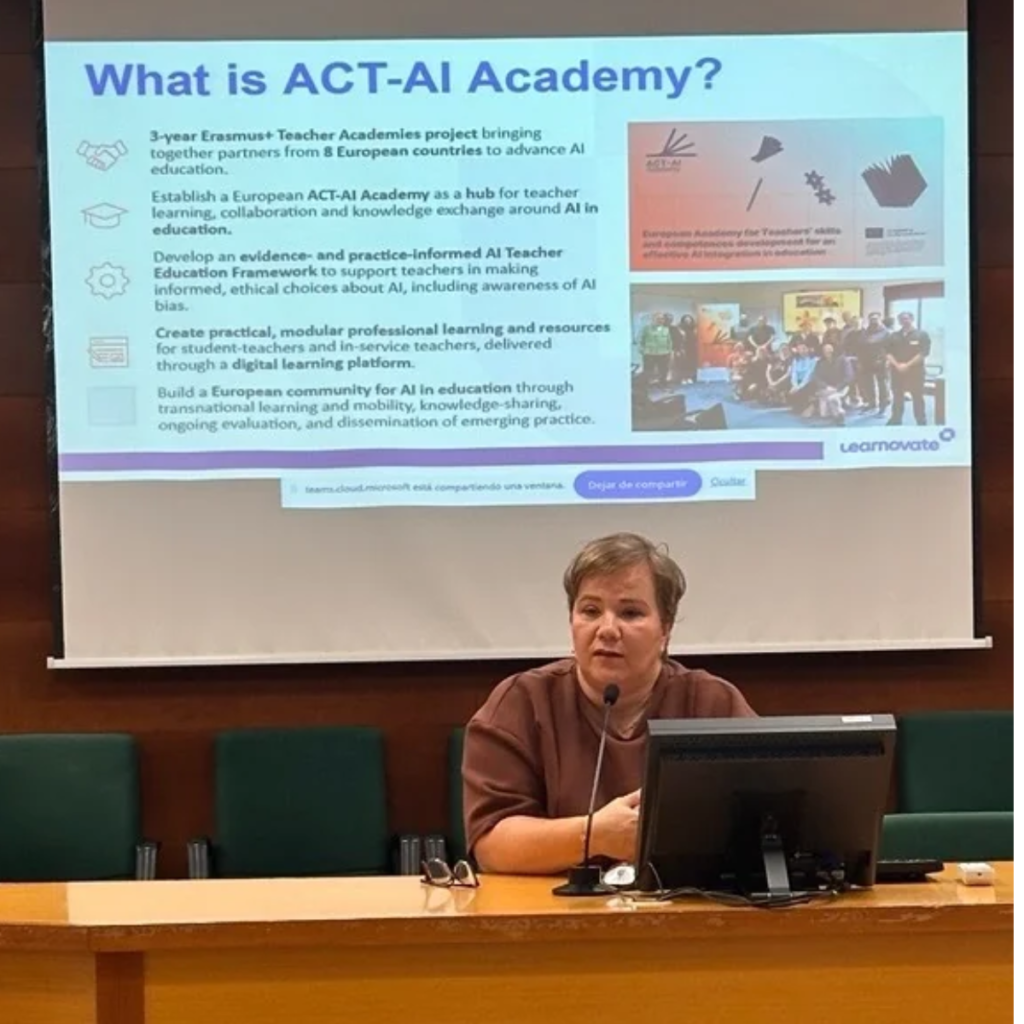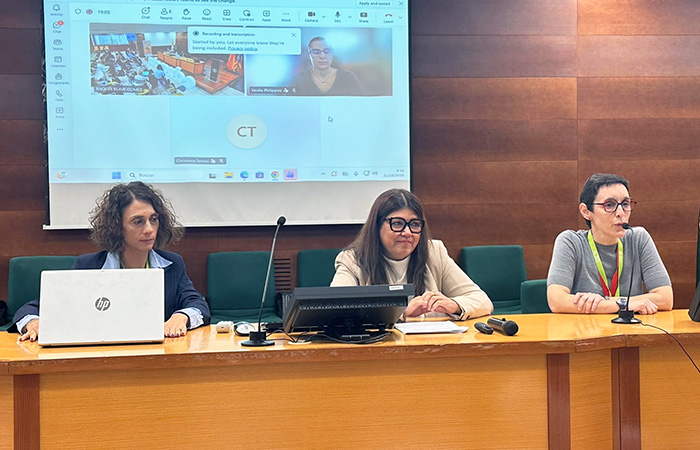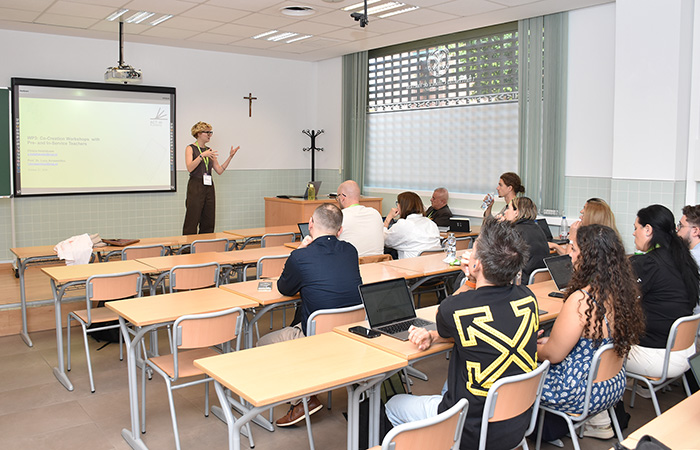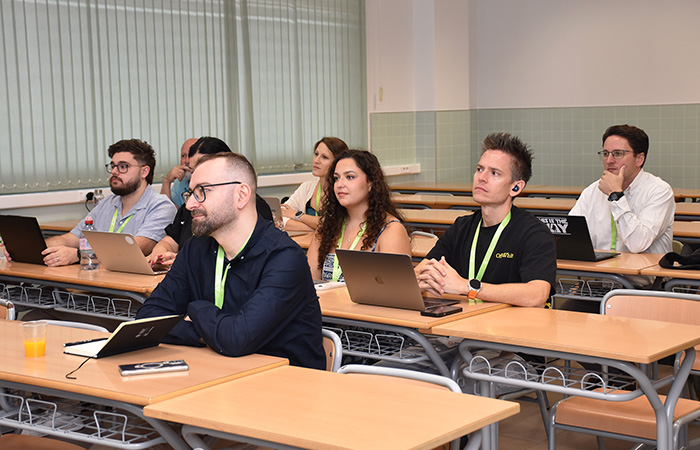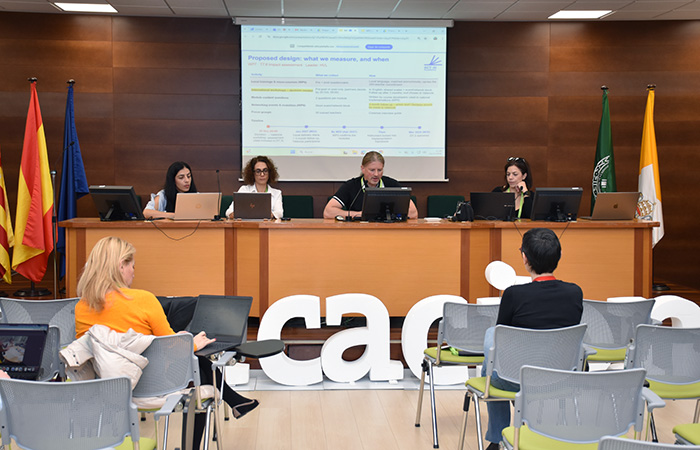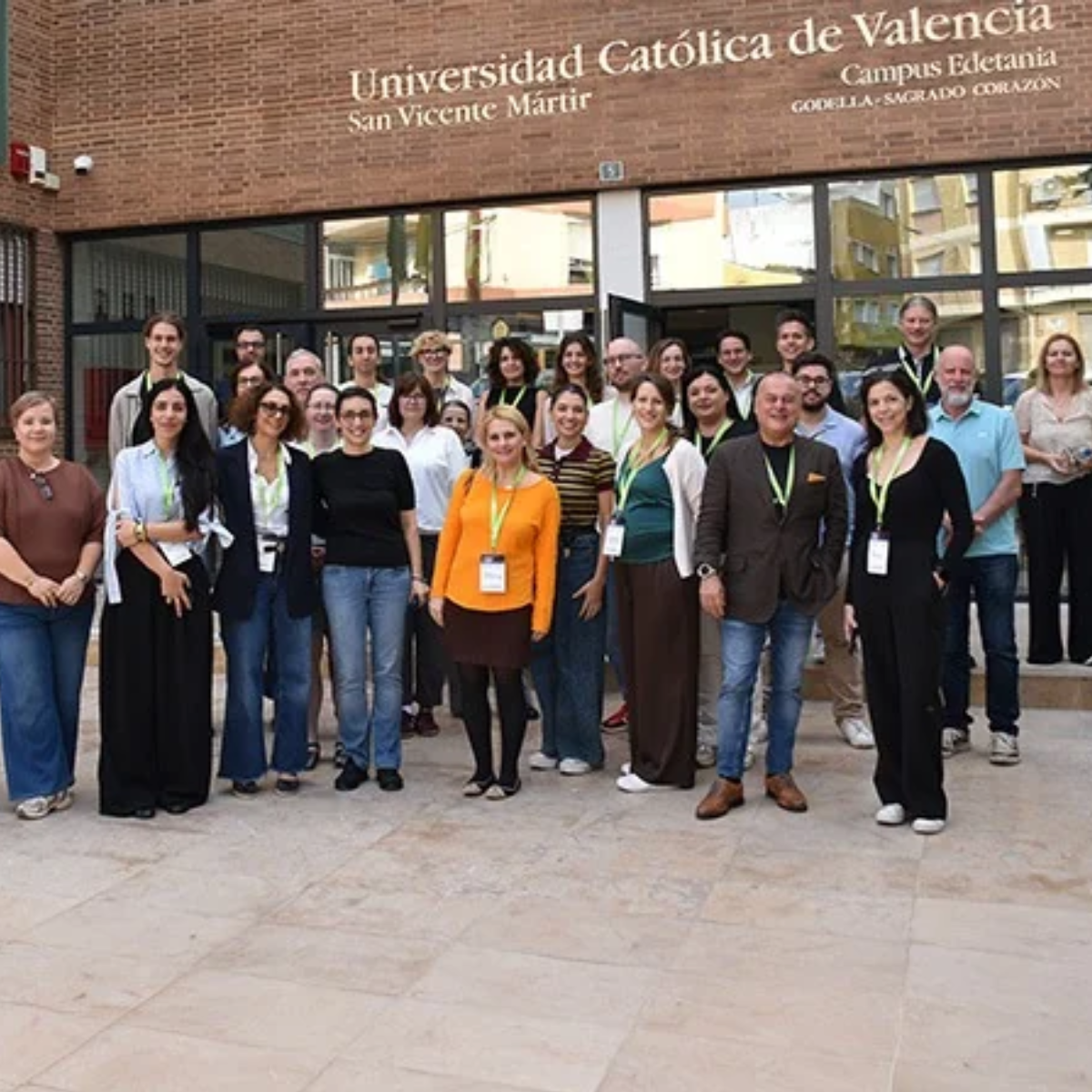
Held at UCV’s Faculty of Education on 21 and 22 October, the two-day event brought together 34 representatives from 17 organisations across eight European countries: Cyprus, Greece, Spain, Ireland, Malta, Norway, the Netherlands and Belgium.
A European network at work
Although ACT-AI Academy is not an EU-CONEXUS initiative, it involves two universities that are also members of the EU-CONEXUS Alliance: Frederick University (Cyprus), which coordinates the project, and UCV, which hosted the convention and leads the project’s work package on networking and the exchange of good practice. In this role, UCV coordinates international meetings and contributes to the development of training materials.
Ethics before enthusiasm
During the opening session, Ángela Serrano, Dean of UCV’s Faculty of Education, highlighted the importance of international cooperation in addressing challenges that transcend national borders.
UCV lecturer Enrique Estellés introduced the concept of “cognitive offloading”, warning that students may increasingly delegate not only memory tasks but also decision-making and reasoning to AI. He also emphasised that, in some situations, choosing not to use AI may be the most ethical option.
Project coordinator Nikleia Eteokleous stressed that the response to AI should not be to ban or exclude it, but to equip teachers with the skills needed to use it responsibly.
What comes next
Over its three-year duration, ACT-AI Academy will develop eight thematic courses and a digital learning platform for practising teachers, trainee teachers and school leaders. These resources will support education professionals in developing the knowledge and skills needed to navigate the opportunities and challenges of AI in education.
About the project: the ACT-AI Academy consortium
The project is coordinated by Frederick University (Cyprus) and brings together UCV (Spain); the University of Piraeus Research Centre, the University of Peloponnese, Science View and Ellinogermaniki Agogi (Greece); Trinity College Dublin School of Education, Learnovate Centre and Oide Technology in Education (Ireland); INQUIRY FUSE LTD (Cyprus); the University of Malta; Western Norway University of Applied Sciences; the University of Groningen (the Netherlands); and Eummena and European Schoolnet (Belgium).
The Chania Directorate of Primary Education (Greece), the Ministry of Education, Sport and Youth of Cyprus and Bømlo kommune (Norway) participate as associated partners.