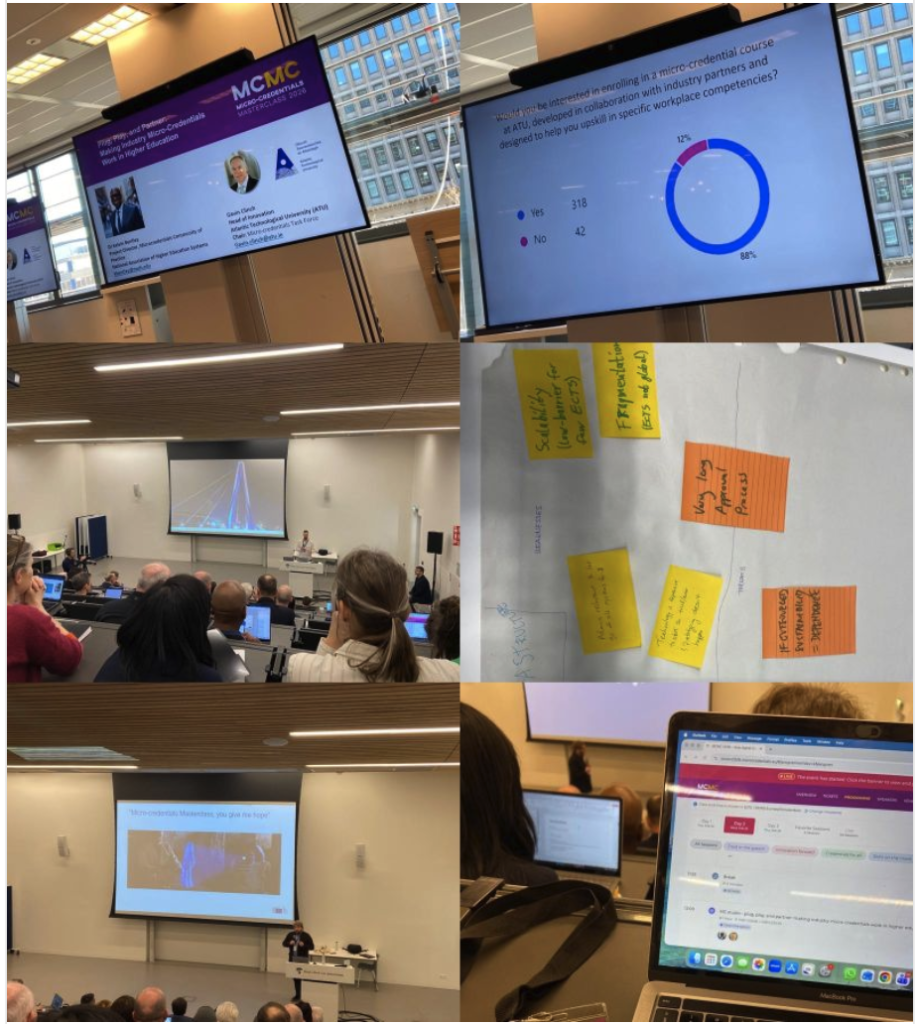

Neill Wylie, Learning Technologist at South East Technological University’s (SETU) Centre for Academic Practice, recently attended a Masterclass on Micro-credentials at the Amsterdam University of Applied Sciences (Hogeschool van Amsterdam). The opportunity was made possible through the EU-CONEXUS Mobility Fund.
The Micro-credentials Masterclass brought together researchers, policymakers and practitioners from across Europe working in micro-credential design, quality assurance and industry collaboration. During the event, Neill connected with colleagues from several European universities of applied sciences and members of the Micro-credentials Community of Practice linked to the National Association of Higher Education Systems (USA).
Speaking about the networking opportunities and the event itself, Neill said:
“These discussions focused on approaches to designing micro-credentials with industry partners and the institutional challenges involved in implementing them at scale. I shared examples of the work underway at SETU in micro-credential design and staff development in learning design.”
Thematic focus and professional development
The event highlighted how many institutions are moving beyond pilot projects and beginning to integrate micro-credentials into their broader educational ecosystems. A key theme was the importance of collaboration between higher education and industry in designing short, targeted learning opportunities that address workforce needs.
For Neill:
“Another important insight was the need to balance flexibility with institutional coherence. While micro-credentials enable agile learning opportunities, institutions must also establish clear frameworks for quality assurance, recognition and sustainability.”
Impact of the experience
Reflecting on the mobility experience, Neill said the opportunity contributed to societal impact by supporting the development of flexible lifelong learning opportunities. Micro-credentials allow individuals to gain targeted skills that respond to changing labour market demands while maintaining access to higher education. The experience reinforced the importance of SETU being part of the wider conversation on micro-credentials.
For Neill, engagement with EU-CONEXUS offers valuable opportunities for both students and staff. Mobility programmes allow participants to connect with colleagues across partner institutions, exchange ideas and gain insights into different educational practices and research priorities.
For staff, these experiences support professional development and encourage collaboration in teaching innovation, research and project development. Exposure to international perspectives can inspire new approaches to curriculum design and digital learning.
Neill explained that the Micro-credentials Masterclass provided an excellent opportunity to engage with current European discussions on the future of micro-credentials and lifelong learning. The event brought together policymakers, researchers and practitioners, creating a valuable space for knowledge exchange and networking.
For information on the EU-CONEXUS mobility fund, click here.