Within the Brain Health and Resilience Valencia Challenge (BHRVC), led by the Catholic University of Valencia (UCV), the NONNA Project is an innovative initiative exploring how language-based interactions with virtual assistants can help detect early signs of cognitive impairment.
NONNA focuses on the idea that everyday conversations contain valuable cognitive markers. Changes in vocabulary, sentence structure, speech fluency, or narrative organisation may appear years before clinical symptoms of cognitive disorders become evident. By analysing these subtle linguistic signals, researchers aim to develop tools that support the earlier identification of cognitive decline.
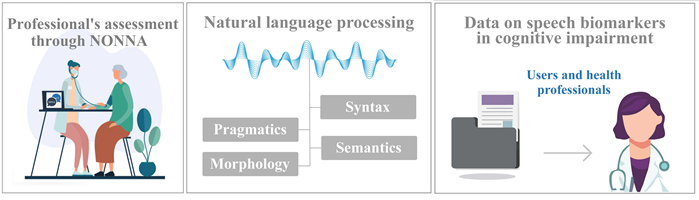
To achieve this goal, NONNA combines advances in artificial intelligence, natural language processing, and digital health technologies. The project is developing intelligent virtual assistants capable of engaging users in natural conversations while analysing linguistic patterns associated with cognitive functioning.
The system includes several key components:
- A conversational virtual assistant – designed to interact naturally with users through everydaydialogue, storytelling, and simple cognitive activities. The assistant encourages spontaneous speech, allowing the system to capture rich language samples during regular interaction.
- Language-based cognitive markers – advanced algorithms analyse aspects of speech and
language such as lexical diversity, syntactic complexity, pauses, semantic coherence, and
narrative structure. These markers may provide early indicators of mild cognitive impairment or other neurocognitive changes. - Continuous and non-invasive monitoring – unlike traditional cognitive tests administered in clinical settings, the NONNA system collects language data through regular conversations at home, making cognitive screening more accessible, ecologically valid, and less stressful for users.
- AI-assisted risk detection models – machine learning models integrate linguistic features with other behavioural indicators to identify patterns associated with early cognitive decline,helping to guide preventive interventions and further clinical assessment.
What makes the NONNA Project particularly innovative is its focus on natural communication as a tool for cognitive health monitoring. Rather than relying solely on structured tests, the system leverages everyday dialogue to capture meaningful cognitive signals.
As part of the Brain Health and Resilience Valencia Challenge, NONNA contributes to the development of next-generation digital tools aimed at promoting brain health, supporting the early detection of cognitive impairment, and empowering individuals to monitor their cognitive well-being over time.