Students Across the Alliance Invited to Design Multilingual, Culturally-Aware Coastal Hazard Warnings for a Chance to Win Cash Prizes.
2026 Jan 14
Students Across the Alliance Invited to Design Multilingual, Culturally-Aware Coastal Hazard Warnings for a Chance to Win Cash Prizes.
News
Student project
Students Across the Alliance Invited to Design Multilingual, Culturally-Aware Coastal Hazard Warnings for a Chance to Win Cash Prizes
The EU-CONEXUS project “Coastal Tongues – Saving Lives Through Languages” is now in motion, putting its innovative vision into practice. This student-led initiative, funded under the alliance’s 3rd Call, explores how local dialects and oral histories can become powerful tools for coastal resilience. Now, we’re calling on you to help build its first public toolkit.
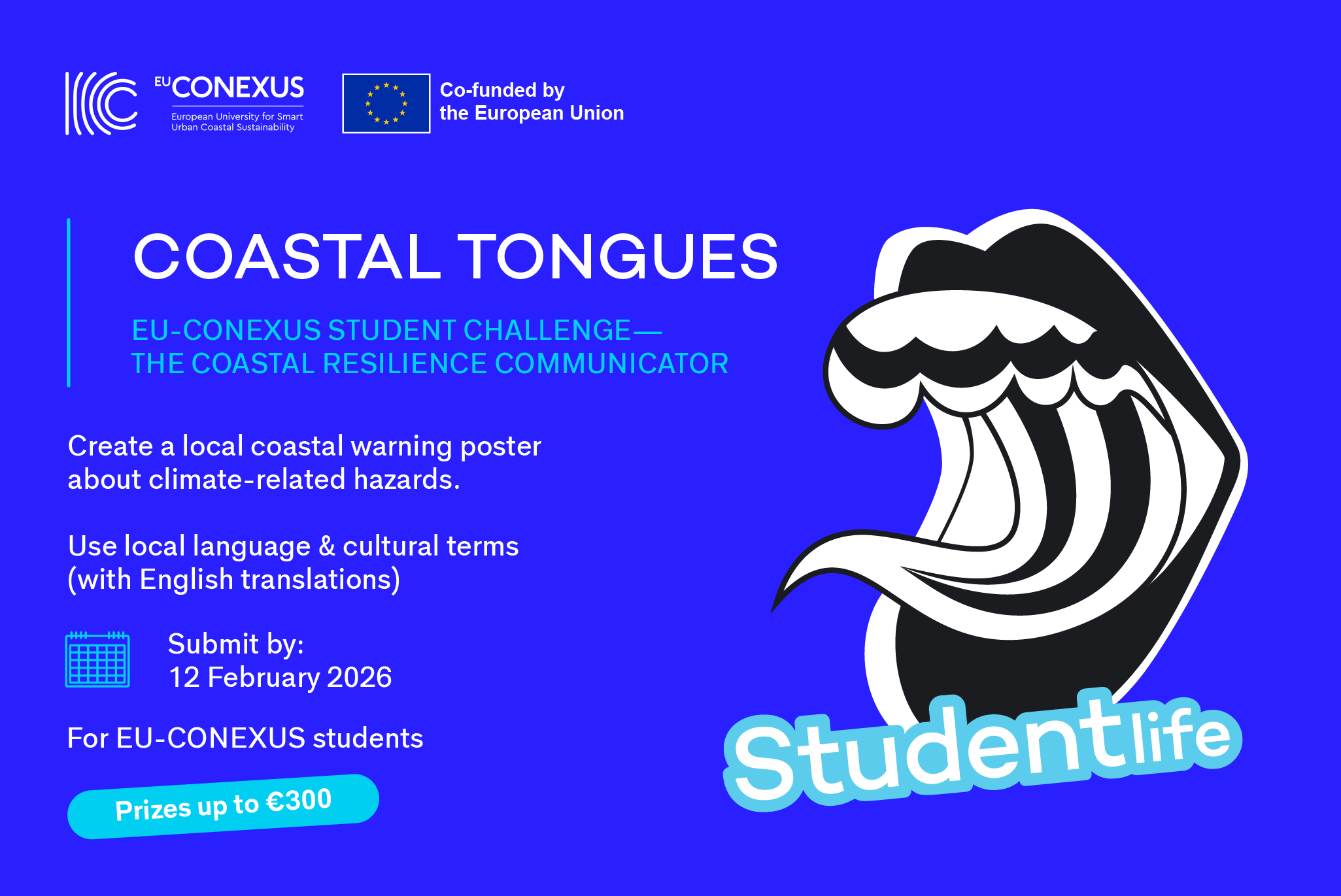
Launching: The Coastal Resilience Communicator Challenge As a key pillar of this project, we now launch an open challenge to all EU-CONEXUS students. Your mission is to create a digital warning poster that acts as a bridge between science and community.
The Challenge (Detailed Instruction below) Design a poster that addresses a real coastal hazard (for example, flooding or storm surges) by blending:
Scientific Research Align with EU-CONEXUS research themes such as: (1) Adaptation to Climate Change in Coastal Environments, (2) Smart Coastal Infrastructure for Disaster Mitigation, (3) Sustainable Disease Management, (4) Protecting Oceans, Seas, and Waters, and (5) Food and Soil
Cultural Knowledge Incorporate traditional local terms, storm names, or historic warning expressions.
Inclusive Communication Present information in a community language and English to ensure everyone understands the risk.
This design competition is an exercise in creating tools that resonate within communities, making scientific warnings culturally relevant and instantly understandable.
Be Part of a Larger Mission Submitted posters will become part of the project’s growing toolkit. “Coastal Tongues” will also deliver a Multilingual Coastal Survival Dictionary, a podcast series documenting oral histories from nine coastal regions, and a living website archive. Your creative work contributes directly to this legacy of building smarter, more inclusive communication infrastructure for coastal regions.
Prizes and Recognition The top three designs will be awarded cash vouchers:
1st Place: €300
2nd Place: €150
3rd Place: €100
All approved entries will be featured on the official Coastal Tongues Instagram account (@eu_coastal_tongues) and may be integrated into the project’s final outputs.
Key Dates
Submission Deadline: 12 February 2026
Winner Announcement: 13 March 2026
How to Participate
Design your high-resolution poster (JPEG).
Write a short 150-word guide explaining where it should be displayed and who it targets.
Help us save lives through language. Design a poster that speaks to your coast.
Contact For questions regarding the challenge, pleasecontact the project teamvia the submission email.
About the “Coastal Tongues” Project
Vision To leverage coastal languages and oral histories as essential tools for disaster preparedness, public health communication, and climate adaptation across the EU-CONEXUS alliance.
EU-CONEXUS Research Alignment The project directly addresses core alliance challenges, including: 1. Adaptation to Climate Change by preserving traditional ecological knowledge encoded in language. 2. Smart Coastal Infrastructure by improving risk communication tools. 3. Sustainable Disease Management by decoding historical terms for health risks such as shellfish poisoning. 4. Protecting Oceans and Ensuring Healthy Food by linking language to conservation practices and food security.
The Team The project is driven by a dedicated, interdisciplinary team of 8 students from La Rochelle University, South East Technological University, Agricultural University of Athens, Klaipėda University, Technical University of Civil Engineering Bucharest, and Universidad Católica de Valencia.
Impact This project aims to save lives by bridging the gap between official bulletins and community understanding, empower coastal voices in climate planning, and provide EU-CONEXUS with a scalable model for student-community collaboration.